Delta Hospice Must Not Be Forced to do Euthanasia.

Alex Schadenberg

Executive Director, Euthanasia Prevention Coalition

Sign the petition: Hospice Organizations Must NOT be Forced to do Euthanasia (Link).

In February 2018 the Board
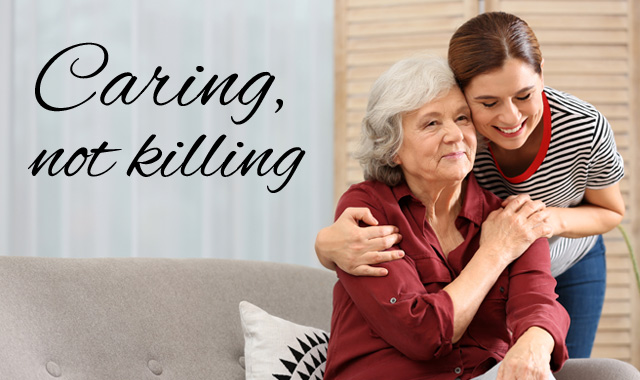
of the Delta BC Hospice was given an Edict from Fraser Health to provide euthanasia (MAiD).

At that time, the Board of the Delta Hospice decided not to do euthanasia and continued its good work.
 

Recently, the Board of the Delta Hospice re-stated its opposition to euthanasia. The new board passed a resolution stating:

MAiD is not compatible with the Delta Hospice Society purposes stated in the society’s constitution, and therefore, will not be performed at the Irene Thomas Hospice.

A spokesperson for Fraser Health told the Delta Optimist that:

it fully supports a patient’s right to receive medical assistance in dying wherever they may be, including in a hospice setting.

The order by Fraser Health is contrary to the stated purpose of the Delta Hospice Society constitution.

Sign the petition: Hospice Organizations Must NOT be forced to do Euthanasia (Link).

If funding for the 10 bed hospice is stopped people in the community requiring care at the end of life, will lose the excellent care provided by the Delta Hospice.

By forcing the Delta Hospice to provide euthanasia, Fraser Health is also redefining the meaning of hospice/palliative care.

In its recent Call to Action, the Canadian Hospice Palliative Care Association and the Canadian Society of Palliative Care Physicians stated that MAiD (euthanasia) is not a part of hospice palliative care. They stated:

MAiD is not part of hospice palliative care; it is not an “extension” of palliative care nor is it one of the tools “in the palliative care basket”. National and international hospice palliative care organizations are unified in the position that MAiD is not part of the practice of hospice palliative care. 

…Hospice palliative care sees dying as a normal part of life and helps people to live and die well. Hospice palliative care does not seek to hasten death or intentionally end life. 

If the Delta Hospice is forced to provide euthanasia then all Hospice Palliative Care organizations within Canada can be forced to provide euthanasia.

Hospice/Palliative Care is not MAiD. The Delta Hospice must not be forced to provide MAiD.

Fraser Health is overstepping its role as a health authority in forcing and bullying the Delta Hospice to provide MAiD.

Sign the petition: Hospice Organizations Must NOT be forced to do Euthanasia (Link).
Western Australia Legalizes Lethal Injection Euthanasia

This article was published by National Review online on December 10, 2019.

Wesley Smith

By Wesley J Smith

The euthanasia darkness seeps into Western Australia. From the Australian Broadcasting Corporation story:

Under the scheme, to be eligible a person would have to be terminally ill with a condition that is causing intolerable suffering and is likely to cause death within six months, or 12 months for a neurodegenerative condition. 

A person would have to make two verbal requests and one written request. Those requests would have to be signed off by two doctors who are independent of each other. 

The choice of lethal medication would be a clinical decision from an approved list of drugs. Self-administration would be the preferred method, but in a departure from the Victorian regime, a patient could choose for a medical practitioner to administer the drug.

“Intolerable suffering” has no objective test. It is whatever a patient says it is — even if the illness is not the reason for the suicide/homicide request.

Where will this lead? Over time, into the bottomless moral pit into which the Netherlands, Belgium, and increasingly Canada have already jumped.

I can’t escape the irony that people seem to lack faith in doctors to care for patients properly and ameliorate their suffering, but ironically, will allow these same doctors to kill them. Bizarre.

Delta Hospice ordered by Fraser Health to do euthanasia.

Alex Schadenberg
Executive Director – Euthanasia Prevention Coalition


Delta Hospice

On December 2, I reported that the Board of the Delta BC Hospice Society that operates the Irene Thomas Hospice in Ladner BC, renewed its position opposing euthanasia (MAiD) while supporting excellent care. The Board stated that:

MAiD is not compatible with the Delta Hospice Society purposes stated in the society’s constitution, and therefore, will not be performed at the Irene Thomas Hospice.

Fraser Health, the government agency that allocates health funding in that region reacted to the Delta Hospice Society by ordering them to provide MAiD (euthanasia).

Sign the petition: Hospice Organizations Must NOT be forced to do Euthanasia (Link).

The Delta Optimist newpaper reported, on December 7, that Fraser Health informed the Delta Hospice that their position is at odds with the policy of Fraser Health.

A spokesperson for Fraser Health told the Delta Optimist that:

The region noted it fully supports a patient’s right to receive medical assistance in dying wherever they may be, including in a hospice setting.

The Delta Optimist also reported that the lobby group, Dying With Dignity, also believes that the Delta Hospice should be forced to do euthanasia:

Alex Muir with the Vancouver chapter of Dying with Dignity Canada called the new board’s vote to repeal MAiD disappointing, adding his group believes Delta Hospice should be forced to abide by Fraser Health policy that MAiD be provided in all non-faith-based facilities under its jurisdiction.

Muir then added that Dying With Dignity considers palliative care and MAiD to be essential options on a spectrum of care.

Delta Hospice President
Delta Hospice President, Angelina Ireland

The position of the Delta Hospice is not new. In February 2018, the Delta Hospice was ordered by Fraser Health to provide euthanasia. The Delta Hospice did not comply with the edict from Fraser Health at that time.

Recently the Canadian Hospice Palliative Care Association (CHPCA) and the Canadian Society of Palliative Care Physicians released a joint statement upholding that hospice palliative care is not compatible with MAiD (euthanasia). They stated:

Healthcare articles and the general media continue to conflate and thus misrepresent these two fundamentally different practices. MAiD is not part of hospice palliative care; it is not an “extension” of palliative care nor is it one of the tools “in the palliative care basket”. National and international hospice palliative care organizations are unified in the position that MAiD is not part of the practice of hospice palliative care.

Hospice palliative care and MAiD substantially differ in multiple areas including in philosophy, intention and approach. Hospice palliative care focuses on improving quality of life and symptom management through holistic person-centered care for those living with life threatening conditions. Hospice palliative care sees dying as a normal part of life and helps people to live and die well. Hospice palliative care does not seek to hasten death or intentionally end life.

If the Delta Hospice is forced to do euthanasia, then all Canadian Hospice groups can be forced to do euthanasia.

Sign the petition: Hospice Organizations Must NOT be forced to do Euthanasia (Link).
Are people being coerced to euthanasia?

Alex Schadenberg
Executive Director, Euthanasia Prevention Coalition

Last week I had the opportunity to screen the Fatal Flaws film and speak in Victoria, Nanaimo and Campbell River British Columbia. Thank you to the local organizers who made this possible.

This article is about three stories from the three events where I spoke.


The first story was from a woman who spoke to me after the Campbell River presentation. She told me that her father has medical issues and has been offered MAiD on several occasions. She said that her father has never brought up the topic of euthanasia and being offered euthanasia feels like a form of coercion.


The second story was a man whose mother requires dialysis. He said that while his mother was feeling down from her dialysis that a nurse suggested that she consider MAiD. Another person then agreed with this suggestion. He said that his mother didn’t bring up the issue of euthanasia and felt coerced by the suggestion. He said that she was feeling depressed and if she did not call him she may have asked for death.

The third story was a woman who told me that she was approved for euthanasia. She appeared to be physically healthy but when speaking to her she seemed to have psychological issues (I am not a professional, this is only my impression).

Now that euthanasia is legal, how are these decisions being made?

Candice Lewis with her mother Sheila

One of the most powerful stories, in the Fatal Flaws film, is the story of Candice Lewis who was pressured by a doctor to ask for assisted death. (Link to the story).


Euthanasia is sold as a form of freedom. In these cases the people felt coerced to ask for euthanasia. In other words, choice can be an illusion.

Western Australia Assisted Dying bill leaves people open to coercion

This article was published by the Sydney Morning Herald on December 9, 2019

By Xavier Symons


Western Australia is set to become the 18th jurisdiction in the world to legalise some form of assisted suicide or euthanasia. Last week its state upper house voted resoundingly in favour of the Voluntary Assisted Dying Bill 24 to 11. A special sitting of the lower house on Tuesday is expected to consider some amendments and then pass it into law.

Labor Premier Mark McGowan has dismissed concerns about the government-sponsored law as “ridiculous”, and has accused opponents of “scaremongering”. He is being unduly sanguine. The Western Australian assisted dying bill is significantly more permissive than the one passed by Victoria in 2017.

Western Australian adults will be eligible for assisted suicide or euthanasia if they have been diagnosed with a terminal illness, have six months or less to live (12 months in the case of neurodegenerative illness), and are suffering in a manner that they deem to be intolerable. A patient must make three requests – two verbal and one in writing – and must be assessed by two medical practitioners.

Unlike Victoria, WA will not require a patient to be assessed by a specialist. Two GPs, for example, could approve a request for euthanasia from a patient with pancreatic cancer or motor neurone disease even if they have never treated patients with these conditions before. Critics warn that non-specialists may provide inaccurate diagnoses and prognoses for terminally ill patients, leading to wrongful deaths. “[If] we get it wrong in relation to a diagnosis, what number [of wrongful deaths] is acceptable?”says former Labor MP Tim Hammond, a vocal opponent of the bill.

Critics also claim that people with mental illness will be at risk. Doctors in Victoria are advised by the state’s legislation to refer patients to a psychiatrist if they have a mental illness that affects their decision-making capacity. The WA bill contains no such provision. Suicide prevention advocate and former SANE Australia director Michael Perrott slammed this oversight, arguing that “we need specially trained people to deal with those who are mentally unwell”.

One hotly debated issue was that the bill will allow doctors to initiate conversations about euthanasia. This is problematic. Doctors may be tempted to suggest the easiest (and cheapest) solution. What if a neurologist proposes euthanasia as “the best option” for a patient diagnosed with an inoperable brain tumour?

This bill exposes patients to undue influence from doctors. In addition, Indigenous groups, culturally and linguistically diverse populations and patients with disabilities may misinterpret a doctor’s words. But it also leaves doctors exposed to pressure from families who want them to recommend euthanasia.

The upper house accepted amendments to an earlier draft, including a clause that ensures that witnesses and practitioners involved in a patient’s application for euthanasia are not beneficiaries of the patient’s will. Yet other amendments were rejected, including provisions for equitable access to palliative care in rural areas and adequate oversight for patients with mental illness.

The method of assisted dying in WA will be either the self-administration of a lethal dose of medication (assisted suicide), or administration of the drug by a medical practitioner (euthanasia). In Victoria, a doctor can only administer the drug if a patient is physically incapable.

This is important. Rates of euthanasia are higher in Canada, for instance, where patients can choose either euthanasia or assisted suicide. There may be a far higher rate of patients in WA choosing to end their lives than most politicians have anticipated.

Victoria’s legislation was described by Premier Daniel Andrews as “the most conservative euthanasia law in the world”. Perhaps the Western Australian bill should be described as the most liberal euthanasia law in Australia. It leaves sick and elderly Australians open to coercion at the most vulnerable moments of their lives.

Xavier Symons is a research associate in the Institute for Ethics and Society at the University of Notre Dame.

Another Australian state on the verge of legalising euthanasia

This article was published by Mercatornet on December 6, 2019.

By Richard Egan

At 4:11pm on Thursday, 5 December 2019, the Voluntary Assisted Dying Bill 2019 passed its third reading vote in the Legislative Council of the Parliament of Western Australia by a decisive vote of 24 to 11.

Only one member changed her vote between the second and third readings: Labor MP Adele Farina.

Adele Farina MP

In her speech explaining her vote Ms Farina highlighted the defeat of a series of amendments designed to address the inherent problems with a law permitting the prescription of a lethal substance for a person to keep at home for self-administration at some later time.

These problems, as identified in Ms Farina’s speech, and during the consideration in detail, include:

  • The experimental nature of the lethal substances which could be any Schedule 4 or Schedule 8 poison or combination of these poisons with no scientific assessment of their efficacy or of adverse side effects;
  • The reported rate of complications from other jurisdictions of between 5 percent and 17 percent, including regurgitation, seizures, failure to be fully unconscious before asphyxiation or heart attack occurs, lengthy time from ingestion to death, and failure to die; 
  • The lack of any requirement for a health practitioner or, indeed any witness, to be present at the time the poison is taken; 
  • No system for reporting adverse outcomes even if a medical practitioner or other witness is present; 
  • No assessment of the decision-making capacity of the person after the lethal poison is issued (even though it may be kept for months or even years); 
  • No way of ensuring that the person is taking the lethal poison voluntarily – the person could be tricked, cajoled or even forced into ingesting it. 

Ms Farina also spoke about the pressure put on her to support the government’s position on the Bill. To her credit she resisted this pressure and voted according to her conscience.

Greens MP Alison Xamon expressed significant concerns with the Bill but was bound by Greens Party policy to support it. She said “I also remain concerned that the safeguards are insufficient. However, with all my heart I hope that my concerns are proven to be without foundation because it will weigh very heavily on my conscience if my concerns ever come to fruition.”

The Minister for the Environment and for Disability Services, Stephen Dawson, who had the carriage of the Bill in the Legislative Council, reported that it had taken 78 hours and 43 minutes to “consider and debate the 184 clauses contained in the bill”. This equates to just 25 minutes and 40 seconds per clause.

This detailed consideration did result in the passage of 55 amendments (25 moved by Nick Goiran, the leading opponent of the Bill; 18 by the government; 4 by Adele Farina and 8 by three other members), which, contrary to the characterisation of euthanasia lobby Go Gently as “mainly grammatical”, dealt with substantial matters. These included:

  • Prohibiting a healthcare worker, other than a medical practitioner during a medical consultation, from initiating a discussion on euthanasia or assisted suicide with a person;
  • Requiring a medical practitioner who initiates such a discussion to also discuss treatment options and palliative care; 
  • Ensuring that medical or nurse practitioners involved in the process are not beneficiaries under the person’s will; and 
  • In the case of euthanasia (ie, practitioner administration of a lethal poison) requiring the practitioner to report adverse events; 

However, many important amendments were defeated – in some cases by just one vote. These included:

  • Requiring at least one of the medical practitioners involved to have some specialist qualifications or experience in the relevant condition;
  • Ensuring equal access for Western Australians in rural areas to palliative care (as well as equal access to euthanasia and assisted suicide which the Bill guarantees) – defeated by one vote with Nationals voting against the amendment; and 
  • Involving a psychiatrist or other relevant expert in assessment of decision making capacity; 
Hon Nick Goiran MP

In his third reading speech the Hon Nick Goiran summed up his reasons for opposing the Bill:

The desire of a significant proportion of confident people for ready access to lethal injections ought never override the rights of the quiet vulnerable to safety and protection.

Secondly, if we are intellectually honest and reason through the theory of a euthanasia regime, we should conclude that it is inherently unsafe. The insufficiency of the criminal justice safeguards informs us of this; the prevalence of medical negligence informs us of this; the ease of doctor shopping informs us of this; the reality of doctor bias informs us of this; and the evidence of elder abuse informs us of this.

When we engage with the lived experience of the very few jurisdictions that have legalised euthanasia or assisted suicide, we know that the theory of an inherently unsafe regime has resulted in casualties of wrongful deaths.

Ultimately, there is another way; there is a better way. There is a safe approach to end-of-life choices. However, it will require all of us to persistently insist that quality palliative care is made available to every Western Australian.

The Bill now returns to the Legislative Assembly where the 55 amendments made to it will be considered on Tuesday.

The government has repeatedly stated that it will be at least 18 months before the Bill comes into effect. As Ms Farina stated in her speech “We were told on no less than 77 occasions that [problems identified in the debate] will be sorted during the 18-month implementation phase.”

Western Australia will become the 18th jurisdiction in the world to enact a fatally flawed scheme for the State-sanctioned, extra judicial termination of the lives of its citizens by euthanasia and/or assisted suicide.

Richard Egan is a researcher who has studied euthanasia and assisted suicide laws for 35 years and is the author of Seventeen Fatally Flawed Experiments in Assisted Suicide and Euthanasia and Twelve Categories of Wrongful Death from Assisted Suicide and Euthanasia

Moral Challenges exist for nurses around euthanasia.

Alex Schadenberg
Executive Director, Euthanasia Prevention Coalition

Nurses are conflicted with assisted deaths

Barb Pesut

UBC Okanagan nursing professor and Canada Research chair in health, ethics and diversity, Barb Pesut, was interviewed by Daniel Taylor for the Lake Country Calendar.

In her interview Pesut comments on the moral challenges faced by nurses with euthanasia. She states:

The question that haunts me is whether nurses have been sufficiently prepared to make an informed choice about their decision to participate, or not, in MAiD,” 

“There is a prevailing tendency to assume that what we make legal is de facto also right.”

Pesut, who recently published a study on why people choose MAiD, commented on MAiD’s effect on nurses.

According to the study, there is a grey area regarding the eligibility criteria for an assisted death. This grey area is really the area of clinical judgment. The courts have recognized that many of the decisions related to the assessment of eligibility for MAiD are medical, not legal decisions. 

This has the potential to lead to quite a bit of variability in determining who is eligible to choose for MAiD and who is not. 

The study found that this was such a different death experience for nurses who were tasked with the patients’ care. 

Some of those who were undergoing MAiD looked relatively well compared to those patients who they normally treated at end-of-life.

The Euthanasia Prevention Coalition has been contacted by nurses who are being pressured to participate in euthanasia. Nurses often have less freedom than doctors to decide what they are willing to do and nurses lack effective conscience protection.

Message to palliative care leaders – Hold fast to opposing MAiD.

The letter below is in support of the Canadian Hospice Palliative Care Leaders – Joint Call to Action.

Send your letters supporting the Call to Action to:

Leonie Herx MD PhD FCFP (PC)
President – Canadian Society of Palliative Care Physicians (CSPCP)
1A – 12830 – 96th Avenue., Suite 584
Surrey, British Columbia V3V 0C2
Leonie.Herx@kingstonhsc.ca

Sharon Baxter, MSW
Executive Director
Canadian Hospice Palliative Care Association (CHPCA)
Annex D, Saint-Vincent Hospital
60 Cambridge Street, North
Ottawa, Ontario K1R 7A5
SBaxter@chpca.net

Dear Dr. Herx and Ms. Baxter

I am writing to celebrate and support the joint statement of the CHPCA and the CSPCP that distinguishes the difference between palliative care and MAID.

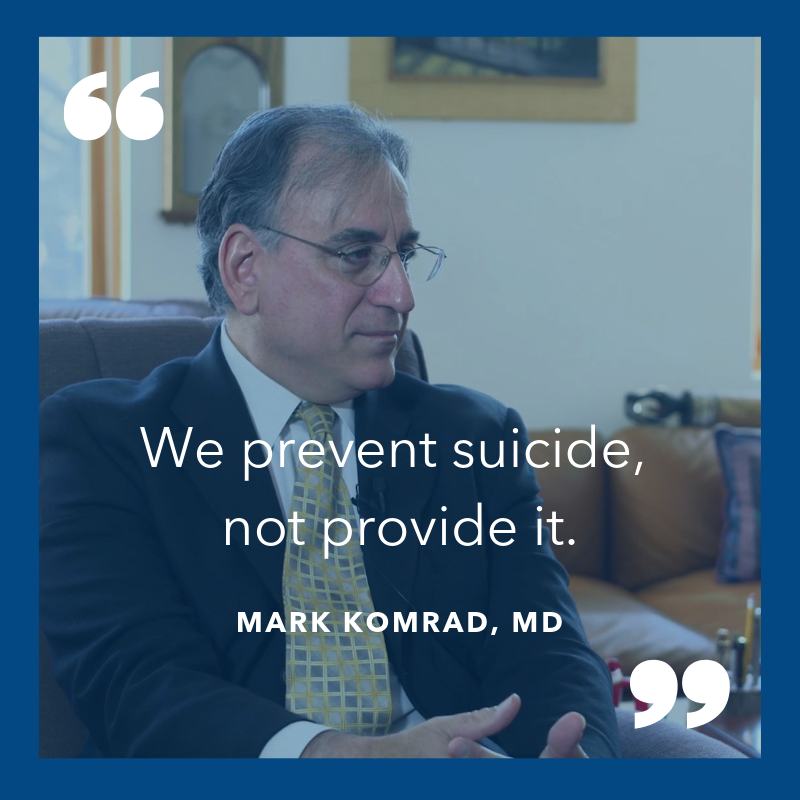
Palliative care is one of the most important bastions of Hippocratic medicine, in which patients can be reassured that they will receive care and comfort, but not be killed. Killing does not belong anywhere in the House of medicine, especially in palliative care.

I am a psychiatrist and medical ethicist who has been very involved in the U.S. and internationally— lecturing, publishing and publically debating the issue of MAID. I argue that it is neither good medical ethics nor good public policy. Along with this, I have been promoting palliative care as an approach that needs more access, funding and training programs. Physicians and our teams certainly can get out of the way of death, without administering death to patients.

The American Psychiatric Association (APA) stands with the American Medical Association (AMA) against all forms of MAID. I helped to craft and establish the APA’s special position statement that focuses particularly on MAID for people with non-terminal conditions, such as psychiatric patients – stating that those practices are unethical: (Link)

If you would like to read more about my own efforts and on these issues there is a summary here: (Link).

Please continue to hold fast to your venerable ethical stance as pressure comes from organizations that are trying to push MAID down the slippery slope, through Palliative Care and beyond.

Regards,
Mark S. Komrad M.D., DFAPA Faculty of Psychiatry, Johns Hopkins, Tulane, and University of Maryland Author of, “You Need Help: A Step-by-Step Plan to Convince a Loved One to Get Counseling.” 
www.YOUNEEDHELPBOOK.com 
@youneedhelpbook

Québec government begins consultation on expanding euthanasia for Alzheimer’s

Alex Schadenberg
Executive Director, Euthanasia Prevention Coalition

Last September,Québec Justice Christine Baudouin expanded Canada’s euthanasia law by striking down the “terminal illness” requirement in the law


By striking down the terminal illness requirement, the court expanded euthanasia to people who are not dying and to people with psychiatric reasons alone.

On Friday the Québec government announced the creation of an all-party consultation to examine expanding the euthanasia law.  The Québec government is considering expanding euthanasia to people with Alzheimer’s.

In his ipolitics report, Kevin Dougherty wrote:

Quebec Health Minister Danielle McCann, accompanied by three opposition members in the provincial assembly, announced on Friday an all-party consultation on opening up the province’s law on physician-assisted suicide. 

The Quebec law, adopted in 2014, two years before the federal government’s Bill C-14, now requires that a person who is mortally ill and near death must make informed consent to medical-assisted death before it is allowed. 

McCann commissioned a panel of 22 experts to look into allowing medically assisted death in cases where the patient was no longer apt to affirm such consent or when the timeline of the disease means death may be certain but not imminent, such as Alzheimer’s and other degenerative diseases.

Currently the euthanasia law requires that a person be capable of consenting, at the time of death.

Luc Ferrandez

Nico Johnson, writing for the Post Millennial  suggested that Luc Ferrandez, a Québec politician and environmentalist supports euthanasia for people who do not want to be a burden on society. Johnson wrote:

Writing in a Facebook post, the former mayor of Plateau Mont-Royal said, “Could we, for environmental, social and economic reasons, decide that we want to receive help to die so as not to be a burden for our family and society in general?”

Québec has its share of problems with euthanasia. Recently a Québec man asked for euthanasia based on his living condition while another Québec man claimed that his psychologist urged him to kill his wife.


The recent Québec euthanasia report stated that there were 1331 reported euthanasia deaths (April 1, 2018 to March 31, 2019). 13 of the reported deaths did not fit the criteria of the law and 3 of the euthanasia deaths were for hip fractures

Canada has sadly become the example of how euthanasia can quickly expand, once legalized.

Québec man asked for euthanasia based on nursing home living conditions

Alex Schadenberg
Executive Director, Euthanasia Prevention Coalition

CHSLD Valcourt

A Québec man who is scheduled to die by euthanasia on December 5, says that he asked for euthanasia, not based on his degenerative health, but due to his untenable living condition at CHSLD in Valcourt.

Mélanie Noël, reporting for La Tribune on November 30, states that Raymond Bourbonnais will die by Medically Aid in Dying because his health condition allows it and his living conditions are unacceptable. 

Mr Bourbonnais is urging the government to improve conditions. Noël reports (google translated):

“After a year in a CHSLD where I have noticed a constant deterioration of services, I would ask you to do everything possible to put pressure on the government to wake up its senior officials who sleep in their air-conditioned offices. The problem of manpower has become a daily concern and it worsens dangerously on weekends,”

Noël continues (google translated):

Summer was a particularly difficult time for Mr. Bourbonnais. “The heat went up to 27, sometimes 30 degrees in my room. We can not open the windows and the CHSLD does not allow users to install air conditioning in their room.”

Residents enter and leave Mr. Bourbonnais’ without being invited. “There is a lady who moves all my things. And since I am paralyzed, I no longer have them at hand. And a man, always the same person, has repeatedly attacked me physically. Shake my arm or grabs my buttocks. When he came out of the room here, the other residents around him were shouting, ‘Go to your room!'”

Mr. Bourbonnais complained. He was told that it was serious and that things would change.

“A month later, he was still walking around wherever he wanted. Fortunately, he has a harder time getting around lately,”

Mr. Bourbonnais decided that when he was unable to be moved to his wheelchair, then he would have had enough. Noël reports (google translated):

“I would ask you to be indulgent, my abilities are limited. As most of you already know, I had a busy life. I have never missed a job and I have always volunteered, parish, municipal, cooperative or at the snowmobile club. I always fought. Now it’s not possible,”

When euthanasia was legalized, we predicted that people would ask for death based on living conditions. We have no idea how many cases, similar to Raymond Bourbonnais and Roger Foley, have occurred in Canada.

Design a site like this with WordPress.com
Get started