The Great Game Round-Up brings you the latest newsworthy developments regarding Central Asia and the Caucasus region. We document the struggle for influence, power, hegemony and profits between a U.S.-dominated NATO, its GCC proxies, Russia, China and other regional players.
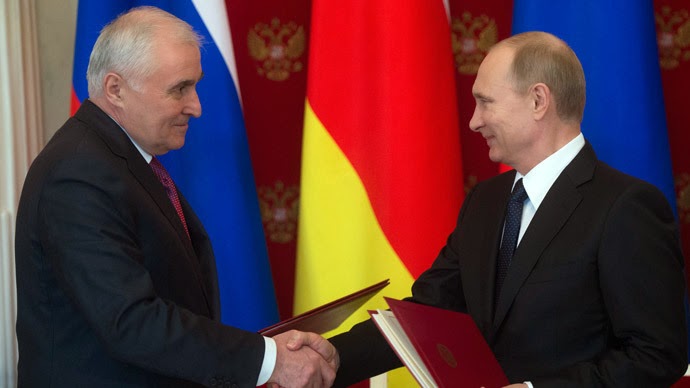
With all eyes focused on Ukraine, recent developments in the South Caucasus have gone largely unnoticed but tensions are running high on Russia's southern border as well. Not everyone is fond of NATO's relentless expansion into post-Soviet space. Contrary to what Western media would have you believe, “it's NATO that's empire-building, not Putin” and some people are having second thoughts about joining “an aggressive military bloc.” Georgian businessman and parliamentarian Gogi Topadze, leader of one of the parties of the ruling Georgian Dream coalition, suggested a few days ago that it might be better to join the Eurasian Economic Union (EEU). Predictably, it didn't take long before some of the most influential Georgian NGOs, including George Soros' Open Society Georgia Foundation, launched a petition against Topadze's “anti-Western statements.” As members of the Georgian government never grow tired of emphasizing, Georgia's Euro-Atlantic integration is irreversible. The next step on this path is a NATO training center. But for some inexplicable reason, this doesn't go down particularly well in Georgia's breakaway region of South Ossetia. South Ossetian leader Leonid Tibilov recently cited NATO's activities in Georgia and Tbilisi's refusal to sign a document on the non-use of force against South Ossetia and Abkhazia as key reasons for signing a wide-ranging alliance and integration treaty with Russia:
Putin signs treaty integrating South Ossetia into Russia
Russia tightened its control Wednesday over a second breakaway region of Georgia, with President Vladimir Putin and the leader of South Ossetia signing a new treaty that calls for nearly full integration.
Georgian President Giorgi Margvelashvili denounced the signing as a “destructive” move against his nation's sovereignty and territorial integrity and said it would further exacerbate tensions. The United States, the European Union and NATO also strongly condemned the signing.
Under the agreement signed Wednesday in the Kremlin, South Ossetia's military and economy are to be incorporated into Russia's. The treaty also promises to make it easier for South Ossetians to get Russian citizenship and to raise salaries for civil servants and state pensions.
 |
| © Photo RIA Novosti/Aleksey Nikolskyi |


 The Venezuela News, The Venezuela Latest